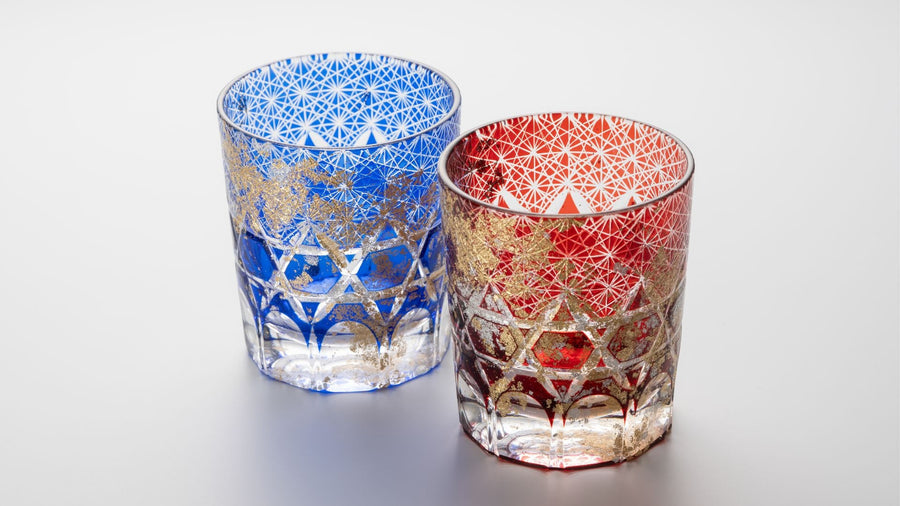
Hikari Kiriko Glass: Where Edo's Ancient Cut Glass Meets Gold Leaf Brilliance
The Japanese craft that catches light like nothing else — now available to the world.
There's a moment when you lift a Kiriko glass toward the light and the room changes. Facets carved by hand scatter the light into shards of brilliance across the table, the wall, the air. It's not a trick of design — it's centuries of Japanese glasscraft doing exactly what it was always meant to do.
The Hikari Kiriko Glass by KAGAMI takes that moment further. By fusing two of Japan's most demanding decorative traditions — Edo Kiriko cut glass and Hakumai gold leaf — it creates something that feels less like a drinking glass and more like a small piece of architecture you can hold in your hand.
What Is Edo Kiriko?
Edo Kiriko (江戸切子) is a style of cut glass that originated in Tokyo (then called "Edo") in the early 19th century. Unlike mass-produced crystal, each piece is shaped entirely by hand: a craftsman presses the glass against a rotating iron or stone wheel, carving geometric patterns — diamonds, chrysanthemums, hemp leaves — in precise, overlapping layers.
The craft requires years of training. A single misplaced stroke ruins the piece. There are no digital guides, no laser templates. The pattern lives in the craftsman's hands, refined across thousands of repetitions until muscle memory becomes art.
Today, fewer than 300 certified Edo Kiriko craftsmen remain in Japan. Each Hikari Kiriko Glass represents their work at its most concentrated.
The Gold Leaf Detail That Changes Everything
What makes the Hikari Kiriko Glass distinctive within the Kiriko tradition is the addition of Hakumai gold leaf — ultra-thin sheets of pure gold, applied to the surface with a technique rooted in Japanese makie lacquerware tradition.
Gold leaf at this scale (far thinner than a human hair) doesn't simply add color. It catches and reflects light differently than glass alone, creating a layered luminosity: the cut facets scatter light outward, while the gold leaf holds a warmer, softer glow within. The effect shifts depending on the angle you hold the glass and the light source behind it.
The result is a glass that looks different every time you pick it up — which is, in the end, the highest compliment you can pay to any handmade object.
KAGAMI: The Workshop Behind the Glass
KAGAMI is one of Tokyo's most respected Kiriko studios, with roots going back generations in the Sumida district — the historic heart of Edo Kiriko production. The brand has spent decades refining the balance between traditional craft integrity and contemporary design sensibility.
The Hikari Kiriko Glass represents their most ambitious product to date: not just a Kiriko piece, but a collaboration between glass-cutting and gold leaf application, two disciplines that rarely share the same object.
Why This Glass on Your Table
We don't often think carefully about what we drink from. But the vessel shapes the experience — the weight in your hand, the coolness against your lip, the way a glass of whisky or sparkling water looks before you even bring it to your mouth.
The Hikari Kiriko Glass was designed with this in mind. At a practical level, it's weighted for comfort, sized for everyday use, and crafted to be used — not displayed behind glass. At an experiential level, it transforms even a glass of water into something worth pausing over.
This is what the best Japanese craft has always done: elevate the ordinary moment without demanding you acknowledge it.
Funding Now on Kickstarter — Already 169% Funded
The Hikari Kiriko Glass launched on Kickstarter and has already surpassed its funding goal by 169%, with strong backing from supporters across the US, Europe, and Asia.
Backers receive the glass at early-supporter pricing, with a commitment to the same production quality standards as KAGAMI's domestic Japanese market pieces — no compromises for export.
Back the Hikari Kiriko Glass on Kickstarter →
The campaign closes soon. Once it ends, the next opportunity to own one may come at a significantly higher retail price — if stock is available at all.
The Bigger Picture
Japan's traditional craft sector faces a real challenge: extraordinary skill, shrinking markets, and an aging artisan population. Edo Kiriko is no exception. Without international demand, studios like KAGAMI cannot sustain the apprenticeship structures that keep these techniques alive.
When you back the Hikari Kiriko Glass, you're not just buying a beautiful object. You're becoming part of the supply chain that keeps a 200-year-old craft financially viable for the next generation of Japanese craftsmen.
It's a rare case where the beautiful thing and the right thing happen to be the same purchase.
ModernJapanCrafts curates Japanese traditional craft for a global audience. We work directly with makers and studios to tell the story behind the object — because craft without context is just product.